
Quick Answer
A medical invitation letter is an official document from a Chinese hospital proving you've been accepted for treatment. It's required for S2 visas (private affairs, 30-180 days) and S1 visas (long-term, 180+ days). You can handle it yourself or have someone coordinate for you.
Honestly, the process isn't complicated — the real bottleneck is language. Hospital international departments almost exclusively communicate in Chinese. In my experience, patients who handle it themselves spend an extra 1-2 weeks just on back-and-forth communication. If your Chinese is fine, DIY works. If not, having someone coordinate saves a lot of time.
What Is a Medical Invitation Letter?
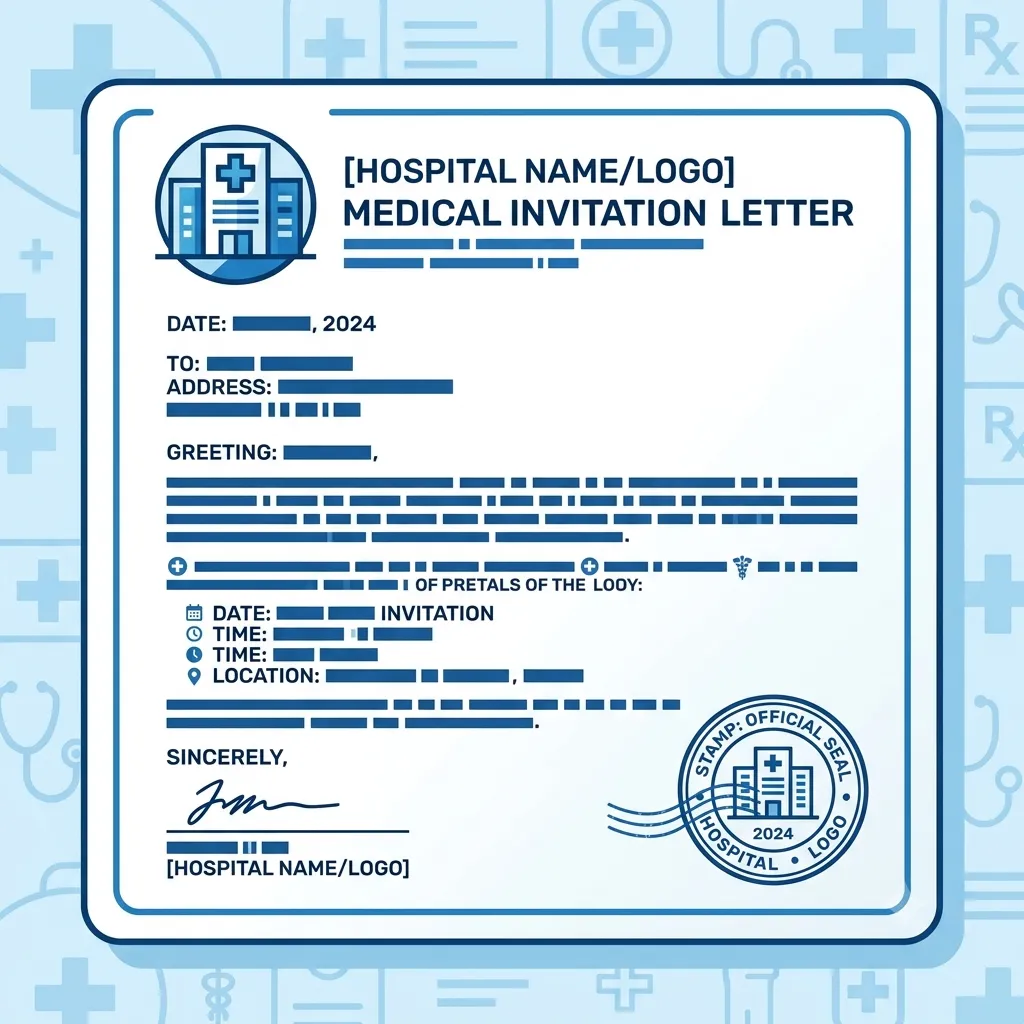
A medical invitation letter (来华就医邀请函) is an official document issued by a Chinese hospital, confirming that you've been accepted for treatment. It's not just a formality — it's the core document for your visa application.
Proof of acceptance
The hospital has reviewed your case and agreed to treat you.
Visa requirement
Required for S2 visas (private affairs) and S1 visas (long-term stay).
Legal validity
Must be issued by a Grade 3A hospital with official stamp and signature.
⚠️ Important: M visas are for business/commercial trade only — not for medical treatment. Medical travelers need S2 (short-term) or S1 (long-term) visas. See the Visa Guide for details.
Who Needs One?
Whether you need an invitation letter depends on your visa type and treatment duration:
| Visa Type | Invitation Letter? | Best For |
|---|---|---|
| Visa-free entry | ❌ Not needed | Short checkups, outpatient visits (under 30 days) |
| 240-hour transit | ❌ Not needed | Transit stopover with quick medical care (under 10 days) |
| L visa (tourist) | ❌ Not needed | Short-term tourism + checkup (under 30 days) |
| S2 visa | ✅ Required | Hospitalization, surgery, recovery (30-180 days) |
| S1 visa | ✅ Required | Long-term treatment, post-op rehab (180+ days) |
Quick check: If you're from a visa-free country AND your treatment is under 30 days → no visa or letter needed. Otherwise, check the Visa Guide.
What's in It?
The invitation letter contains specific information that immigration officers verify:
Patient information
Name, gender, date of birth, passport number, nationality
Medical details
Diagnosis, condition summary, proposed treatment plan, estimated duration
Cost estimate
Projected treatment costs and payment method
Hospital information
Hospital name, address, contact details, receiving department
Official stamp
Hospital seal and authorized signature — must be original
How to Get One
Two paths — pick the one that fits your situation:
Option 1: Have Someone Coordinate
Best for:
- You don't speak Chinese fluently
- You're not familiar with Chinese hospital processes
- You want to save time on back-and-forth communication
Here's what happens:
- 1.You send your medical records (any format is fine)
- 2.They translate and organize them into hospital-ready format
- 3.They contact the hospital's international department
- 4.The hospital reviews your case and confirms acceptance
- 5.You receive the invitation letter (digital PDF)
Invitation letter coordination fee: ¥500 (fully deductible if you book an escort service within 90 days. This is a separate service from the second opinion fee of ¥500)
😅 Honest take: Sounds like an extra cost? But consider this — calling hospitals yourself means navigating Chinese phone systems, waiting for callbacks, and explaining your situation in Chinese. Time is money.
Option 2: On Your Own
Best for:
- Fluent Chinese speakers who can call hospitals directly
- Patients with a specific hospital already in mind
- Those who prefer to handle everything independently
Here's what happens:
- 1.Identify a target hospital (must be Grade 3A)
- 2.Call their international department (usually Chinese only)
- 3.Submit your medical records
- 4.Wait for hospital evaluation (3-5 business days)
- 5.Receive the invitation letter if accepted
⚠️ Important: Most hospital international departments only accept Chinese communication. If you don't speak Chinese, you'll need a translator.
In Shenzhen, hospitals like Peking University Shenzhen Hospital, Shenzhen People's Hospital, and HKU-Shenzhen Hospital have international departments that handle invitation letters.
Step-by-Step Process
Here's the complete journey from medical records to invitation letter:
Prepare your medical records
1-3 daysGather your diagnosis reports, imaging results, medication list, and treatment history. Don't worry about formatting — I'll help organize everything.
Remote consultation (optional but recommended)
3-5 daysA Shenzhen specialist reviews your case and provides a second opinion. This helps confirm you're a good candidate for treatment in China.
Hospital confirms acceptance
3-5 days (don't rush — this is how long it takes)The hospital evaluates whether your case is within their scope and if you're suitable for treatment in China.
Invitation letter issued
1-2 daysThe hospital prepares the official letter with stamp and signature. You receive it as a digital PDF.
Timeline & Cost
Here's what to expect — with Arthur handling coordination vs. doing it yourself:
| Phase | With Arthur | DIY |
|---|---|---|
| Prepare records | 1-3 days | 1-3 days |
| Remote consultation (optional) | 3-5 days | 3-5 days |
| Hospital evaluation | 3-5 days | 3-7 days |
| Invitation letter issued | 1-2 days | 1-2 days |
| Total | 1-2 weeks | 2-4 weeks |
Cost Summary
| Scenario | Breakdown | Total |
|---|---|---|
| With Arthur, no second opinion | Invitation letter coordination ¥500 + Hospital fee ¥100-300 | ¥600-800 |
| With Arthur + second opinion | Second opinion ¥500 + Invitation letter coordination ¥500 + Hospital fee ¥100-300 | ¥1,100-1,300 |
| DIY | Hospital fee ¥100-300 | ¥100-300 |
What You'll Need
Don't stress about having everything perfectly organized. Here's what helps:
Diagnosis report or medical summary*
Chinese or English is fine — I'll translate if needed
Imaging results (CT, MRI, X-ray)*
Reports are enough; original DICOM files are a bonus
Current medication list*
What you're taking, dosage, frequency
Previous treatment history
Surgeries, procedures, hospitalizations
Doctor's recommendation letter
If your local doctor wrote one
Frequently Asked Questions
How long is the invitation letter valid?
Usually 3-6 months, depending on the hospital. I recommend applying for your visa within 1-2 months of receiving the letter.
Can I apply to multiple hospitals at once?
You can, but it's not recommended. Each hospital issues its own letter, which adds time and cost. Pick one hospital that fits your needs.
What if my application is rejected?
Hospitals may decline if your condition is outside their scope or if they don't think China is the right place for your treatment. I'll help you understand why and suggest alternatives.
Do I need to visit the hospital in person?
Not for the invitation letter. Remote evaluation is standard. You'll visit in person only after arriving in China for treatment.
What's the difference between a second opinion and an invitation letter?
A second opinion is a doctor's assessment of your condition. An invitation letter is the hospital's formal acceptance for treatment. The second opinion can support your invitation letter application, but it's not required.
Does the invitation letter need to be notarized?
No. The hospital's official letter with stamp and signature is already legally valid. No notarization needed.
Need it faster?
Some hospitals can expedite urgent cases. Contact me and I'll check what's possible.
I'm not a doctor. I provide translation, coordination, and information services. All medical opinions come from licensed physicians. The invitation letter must be issued by the hospital — I cannot create or substitute it.