
Quick Answer
- Standard Intervention (Stent): ¥25K-60K (simple lesions), about 1/3 of Hong Kong prices
- Complex Surgery (Bypass/Valve): ¥80K-300K, about 1/2 of Hong Kong prices
- Top Specialists: Fuwai Shenzhen (national-level centre), Prof. Wei Minxin at HKU-Shenzhen (minimally invasive cardiac surgery)
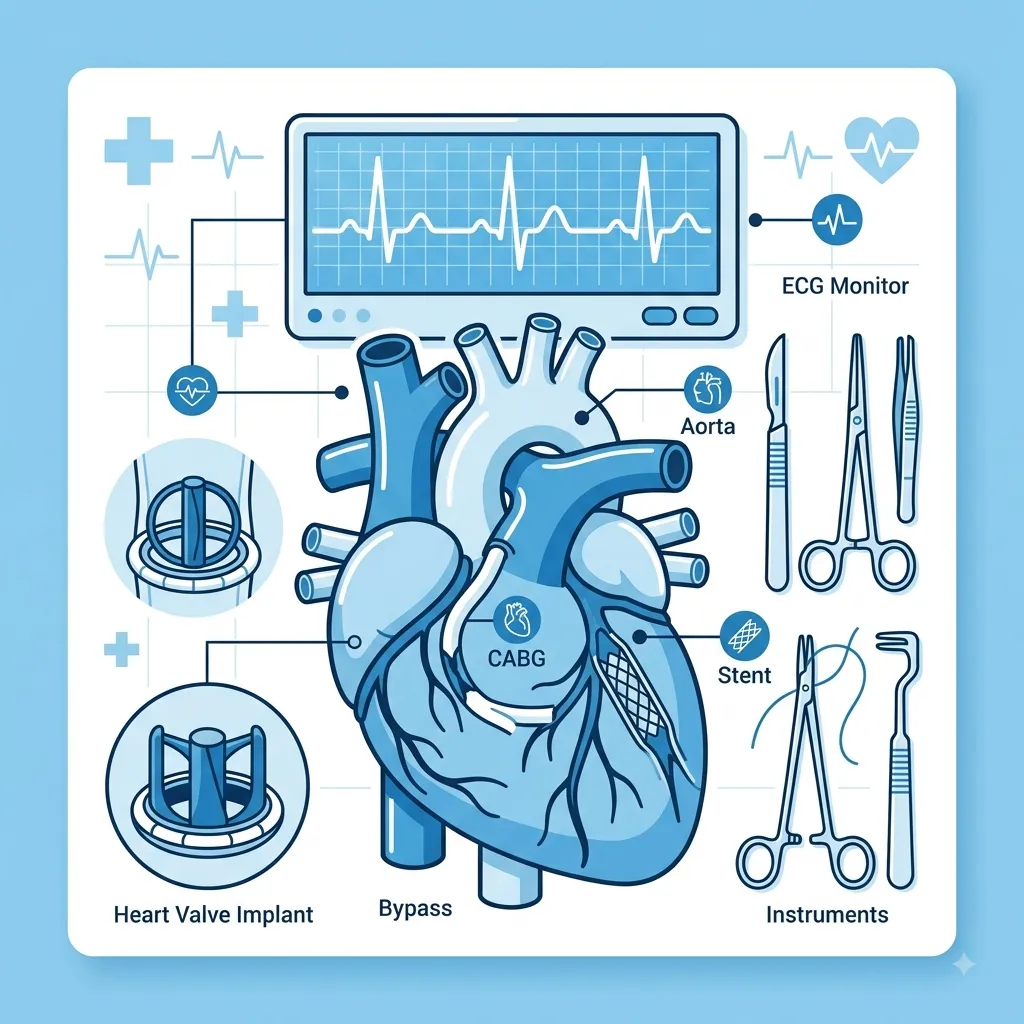
Price Comparison: What Overseas Patients Can Expect
| Procedure | Shenzhen Public (Full Self-Pay) | Hong Kong Private |
|---|---|---|
| Coronary Intervention (Stent) | ¥25K-150K | HK$56K-300K |
| CABG (Bypass Surgery) | ¥80K-300K | HK$250K-800K |
| TAVR (Valve Replacement) | ¥150K-300K | HK$158K-390K |
| Valve Repair/Replacement | ¥60K-200K | HK$200K-500K |
| Arrhythmia Ablation | ¥30K-80K | HK$100K-250K |
| Pacemaker/ICD Implantation | ¥30K-120K | HK$80K-200K |
Shenzhen Full Self-Pay: Estimated ranges compiled from public reports and industry data — Shenzhen public hospitals do not publish full overseas patient package pricing; actual costs depend on in-person consultation quotes. Hong Kong Private: Hospital Authority fee schedule, Hong Kong Adventist Hospital Cardiac Centre, Gleneagles Hong Kong Hospital surgical packages.
Which One? Intervention vs Bypass vs Valve
Coronary Artery Disease / Vessel Narrowing
Intervention or Bypass Surgery
- Single-vessel disease → Intervention preferred
- Multi-vessel disease / Left main → Bypass
- Acute MI → Emergency intervention
Valve Disease
Repair or Replacement
- Valve repair preferred (preserving native valve)
- TAVR suitable for elderly / high-risk patients
- Surgical valve replacement suitable for younger patients
Recommended Cardiology Hospitals in Shenzhen
- Fuwai Hospital Shenzhen: National cardiac center
- HKU-Shenzhen Hospital: Prof. Wei Minxin team, leading minimally invasive cardiac surgery
- Shenzhen Peoples Hospital: Dr. Liu Jingjin, cardiac critical care
- CUHK-Shenzhen 8th Hospital: Prof. Lin Yixian, regular visits
- SMU-Shenzhen Hospital: Shenzhen-Freiburg University Heart Centre
Booking: HKU-Shenzhen IMC +86-755-86913388; Fuwai +86-755-82180999; Shenzhen Peoples Hospital +86-755-25533018. Arthur can help book specialist appointments.
Three-Named Project Specialists: A Unique Cross-Border Advantage
What is the Three-Named Project?
Shenzhen's "Three-Named Project" brings top-tier domestic and international medical teams to practise regularly in Shenzhen. In cardiology, Prof. Wang Chunsheng (Director of Cardiac Surgery, Zhongshan Hospital affiliated to Fudan University) — brought in via HKU-Shenzhen Hospital — is a representative expert. He regularly performs minimally invasive cardiac surgery in Shenzhen, allowing local patients to access top-level cardiac surgical services without travelling to Shanghai.
Insurance & Payment
With International Commercial Insurance
HKU-Shenzhen and others support direct insurance billing
No Commercial Insurance, Overseas Patients
Full self-pay settlement
Mainland Insurance Patients
For reference only
Language Support
Major cardiology hospitals in Shenzhen all have English-language capabilities:
- HKU-Shenzhen Hospital: Fully English-language system, direct insurance billing — best suited for expatriate / HK-Macau patients
- Fuwai Shenzhen Hospital: National-level centre, some doctors have overseas backgrounds
- The 8th Affiliated Hospital of SYSU: Prof. Lam Yat-hin is from Hong Kong — no language barrier in English communication
Arthur's service includes full bilingual (Chinese-English) accompaniment, ensuring smooth communication with your doctors.
Pre-Surgery Checklist
- Bring recent ECG, echocardiogram, coronary CT/angiography reports
- Prepare a medical history summary (onset time, symptoms, previous treatments, medications)
- List current medications (especially anticoagulants and antihypertensives)
- If you have commercial insurance, contact your insurer in advance to obtain pre-authorisation
- Bring HK/Macau ID card / passport with valid endorsement (if applicable); confirm the hospital's overseas patient registration requirements in advance
- Bypass surgery patients: confirm whether a family member will accompany you (post-operative care needed)
- Intervention patients: typically discharged the next day — arrange return transport in advance
Post-Op Recovery Timeline
Days 1-3 Post-Op
- ICU Monitoring — Bypass patients typically spend 1-2 days in ICU; intervention patients transfer to general ward on the same day or next day
- Pain Management — Multimodal analgesia; minimally invasive surgery results in less pain
Weeks 1-2 Post-Op
- Home Recovery — Avoid strenuous activity; take medications as prescribed
- Wound Care — Bypass sternal healing takes approx. 6-8 weeks; avoid lifting heavy objects
Months 1-3 Post-Op
- Cardiac Rehabilitation — Gradually increase activity — walking, cycling, and other aerobic exercises
- Follow-Up Appointments — Review at 1, 3, and 6 months post-op to assess cardiac function recovery
Months 3-6 Post-Op
- Return to Normal — Most patients can resume normal daily life
- Long-Term Management — Control the "triple highs" (blood pressure, blood sugar, cholesterol), maintain medication, regular follow-ups
Cross-Border Follow-Up & Post-Departure Care
Discharge does not mean treatment is over. Cross-border cardiac surgery patients especially need ongoing management after leaving Shenzhen:
- Discharge Documents: You can request the hospital to provide bilingual (Chinese-English) discharge summaries, surgical records, and imaging data (CD/electronic copies), making it easy to hand over to your local doctor in HK/Macau for ongoing care
- Telemedicine: Some doctors at HKU-Shenzhen and Fuwai Shenzhen support online follow-up consultations. If you have questions in the early post-op period, you can consult remotely first to avoid frequent cross-border trips
- Medication Refills: It is recommended to bring adequate medication when leaving Shenzhen (note: personal medication entering HK/Macau is typically limited to no more than 3 months' supply — check customs regulations). Alternatively, hand over discharge documents to your local HK/Macau doctor, who can prescribe based on your condition
- Post-Op Review Schedule: The 1-month, 3-month, and 6-month reviews are key milestones — it is recommended to return to Shenzhen for at least the first two; subsequent follow-ups can be handled by your local doctor based on recovery
Arthur can help arrange your first post-discharge follow-up appointment and cross-border medication preparation consultation.
Real Cases
42-Year-Old Woman's Heart "Rebooted" Through a Small Underarm Incision
A 42-year-old Ms. Wang had a congenital atrial septal defect combined with severe tricuspid regurgitation. Prof. Wei Minxin's team at HKU-Shenzhen Hospital performed right underarm minimally invasive surgery — atrial septal defect repair + mitral valve plasty + tricuspid valve plasty. The entire procedure took just over 3 hours with only a 4cm incision. She was transferred out of ICU and mobilised on day 1, and discharged on day 6.
Traditional cardiac surgery requires splitting the breastbone down the middle, whereas minimally invasive underarm incision surgery offers the advantages of a hidden scar, less trauma, and faster recovery.
Source: HKU-SZ Hospital WeChat ↗
80-Year-Old Grandmother's Heart Problem Fixed With a Single Puncture
An octogenarian grandmother suddenly developed arrhythmia. The team at Sammy Medical Centre successfully treated her through minimally invasive interventional surgery, requiring only a needle-sized puncture site. She was discharged the day after surgery. This type of minimally invasive procedure avoids the high risks of traditional open-heart surgery and is particularly suitable for elderly patients.
Source: Sami Medical Centre WeChat ↗
Arthur's Perspective
Cardiac surgery is the specialty that requires the most "trust" from cross-border patients — heart surgery carries high risks and significant costs, and patient and family anxiety far exceeds that of other specialties.
My advice: if it is just standard coronary intervention (stent placement), Shenzhen's self-pay prices are already very competitive at around ¥25K-150K — more than half the cost of Hong Kong private hospitals, so there is no need to hesitate. For complex surgery (bypass, valve repair), I recommend first getting a comprehensive assessment at HKU-Shenzhen or Fuwai Shenzhen, then deciding after receiving the cardiac team's recommendation.
Special reminder: do not delay treatment out of fear of surgery. The earlier cardiovascular disease is intervened upon, the better the outcome. Shenzhen's minimally invasive cardiac surgery technology is already very mature — many procedures can be done through a small underarm incision with discharge on day 6.